*
*
Daily Readings
Weekly reading
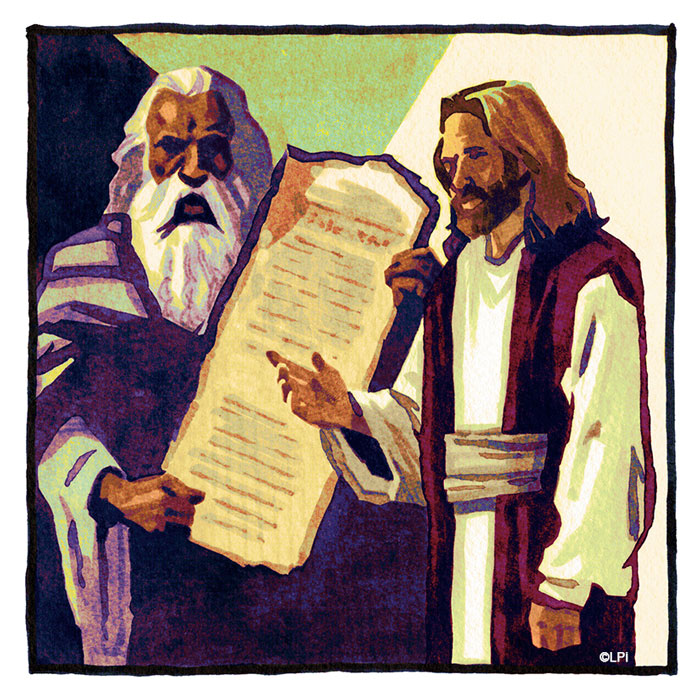
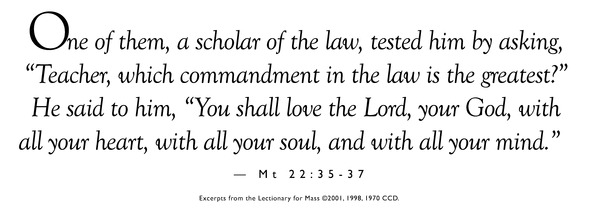
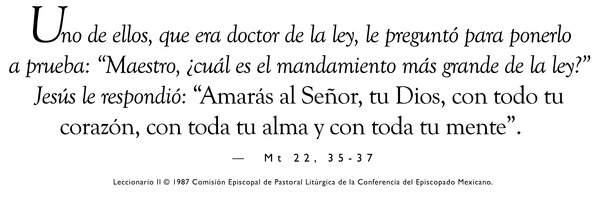
Readings for the week of October 25, 2026
- Sunday: Ex 22:20-26 / Ps 18:2-3a, 3b-4, 47 and 51 / 1 Thes 1:5c-10 / Mt 22:34-40
- Monday: Eph 4:32-5:8 / Ps 1:1-2, 3, 4 and 6 / Lk 13:10-17
- Tuesday: Eph 5:21-33 / Ps 128:1-2, 3, 4-5 / Lk 13:18-21
- Wednesday: Eph 2:19-22 / Ps 19:2-3, 4-5 / Lk 6:12-16
- Thursday: Eph 6:10-20 / Ps 144:1b, 2, 9-10 / Lk 13:31-35
- Friday: Phil 1:1-11 / Ps 111:1-2, 3-4, 5-6 / Lk 14:1-6
- Saturday: Phil 1:18b-26 / Ps 42:2, 3, 5cdef / Lk 14:1, 7-11
- Next Sunday: Rv 7:2-4, 9-14 / Ps 24:1bc-2, 3-4ab, 5-6 / 1 Jn 3:1-3 / Mt 5:1-12a
Pastor Message and Prayer
10/25
Sacrament have Gospel roots
Read Luke, chapter 8
The second part of the Catechism of the Catholic Church, on the sacraments and liturgy, shows an ancient fresco, found in the catacombs, of hemorrhaging woman reaching out and touching the fringe of Jesus’ garment. Why does the Church then, begin its teaching on the sacraments and liturgy with the scene of the hemorrhaging woman touching Christ?
This story is found in the midst of another one. Jairus, an official of a synagogue, urgently requests Jesus to come to his home and heal his dying twelve-year-old daughter. As Jesus travels on the road to Jairus’ home, he suddenly stops and asks: “Who touched me?” Peter responds to Jesus’ question with incredulity: See how the crowds pushes and presses upon you? Peter’s point is simply this, “who hasn’t touched Jesus is the better question!” But Jesus responds, “Someone has touched me; for I know that the power has gone out from me.” Peter’s observation stands: Many did touch Jesus in that pressing crowd. However, there is only one touch, one encounter with Christ that has caused power to go forth from him: the touch of the hemorrhaging woman. Why did her touch unleash the power of God? Because, as Jesus later tells her, she touched him with faith.
“Daughter, your faith has made you well; go in peace.”
LUKE 8:48
Why then, does the Church choose this scene to introduce the Sacraments and Liturgy? Because, the Church is saying that in the Sacraments and Liturgy we encounter Christ. But this grace-filled encounter is not magical. Contact with Christ will not bear the fruit of grace in our hearts unless we encounter him with the faith of the hemorrhaging woman. What a marvel the difference faith makes!
How much of a transforming encounter with Christ is my experience of the sacraments and liturgy?
Prayer starter: Jesus, when I encounter you in the Eucharist, may I touch you with the faith of the hemorrhaging woman, and experience you power.
Lamb of God is the title given to Jesus Christ by John the Baptist (John 1:29). This title appears several times in the New Testament, where Jesus Christ is compared to the Paschal Lamb and remains forever as the picture of the of the sacrificial Lamb of God (Revelation 13:8; John 3:16-17). This title reminds us that Jesus offers his life for us and by his sacrifice we have been reconciled with God (1Peter 1:18-19). When we, God’s people, repeat this title during our Mass, we remember that the Lamb of God is our Lord and Savior, Jesus Christ.
Fr. Joachim
St. Mary Mass Times
Saturday 6:00pm
Sunday 8:30am
Daily Mass Times
Wednesday 8:30am
Wednesday: Adoration of the Blessed Sacrament 9am-9:30am
Friday 8:30am
First Friday 8:30am Healing Mass and Adoration
Confession Times
Saturday from 5:30-5:50 or
by appointment by calling the Rectory at 815-858-3422
St. Mary Office Hours
Wednesday 8:30 am- 3:30 p.m.. by appointment
Thursday 8:30 a.m.-3:30 p.m.